





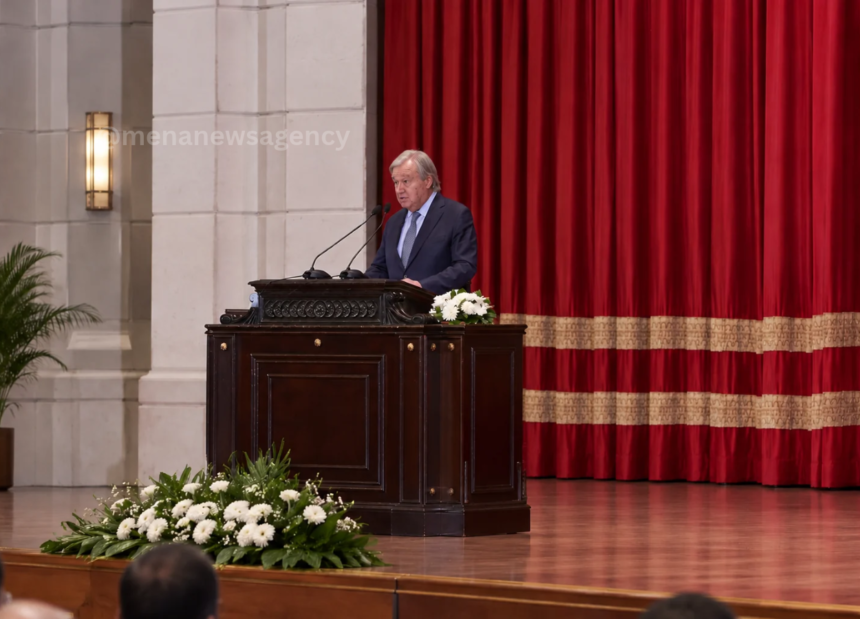

UN Secretary General António Guterres has called for an immediate end to hostilities in Gaza, stressing that achieving any lasting solution in the region depends largely on the protection of basic Palestinian rights. Addressing an audience at a prestigious university within the administrative capital of the Arab Republic, the UN official stressed that regional stability cannot be achieved while self-determination is being violated.
In his speech to academics, diplomats, and students, Guterres pointed out that neither the earlier October incidents nor the subsequent destruction can be justified in the international context. He called for unrestricted humanitarian aid and protection of civilians, as well as compliance with the Security Council resolutions and international legal bodies. Furthermore, the UN leader lauded the North African nation’s ongoing diplomatic mediation, recognizing its vital role in bridging divides and preserving channels for dialogue amidst escalating regional friction.

The high-level address formed a key segment of an official state tour that featured strategic consultations with senior government officials, focusing on regional de-escalation, conflict mitigation, and institutional reforms. Expanding his address to wider geopolitical hurdles, Guterres raised concerns over escalating pressures in the occupied West Bank, warning against forced displacement and settlement expansion. He also addressed broader global instabilities, touching upon ongoing strife in Sudan and Libya while reiterating the necessity of unified regional frameworks driven by local sovereignty rather than external intervention.
Beyond ongoing geopolitical flashpoints, the secretary-general also turned his attention to the sweeping economic and social implications of emerging technology. He cautioned that rapid advancements in artificial intelligence risk deepening global inequalities unless managed responsibly, urging regional universities and policymakers to equip young professionals with the necessary skills and ethical frameworks to navigate tomorrow’s workforce.
Concluding his remarks, the UN chief underscored the immense potential and inherent risks posed by rapid technological advancements, calling on academic institutions to empower future generations through robust ethical frameworks and international collaboration.